 Print book
BUS403 Study Guide
| Site: | Saylor Academy |
| Course: | BUS403: Negotiations and Conflict Management |
| Book: | BUS403 Study Guide |
| Printed by: | Guest user |
| Date: | Friday, February 4, 2022, 9:47 AM |
Navigating the Study Guide
Study Guide Structure
In this study guide, the sections in each unit (1a., 1b., etc.) are the learning outcomes of that unit.
Beneath each learning outcome are:
- questions for you to answer independently;
- a brief summary of the learning outcome topic;
- and resources related to the learning outcome.
At the end of each unit, there is also a list of suggested vocabulary words.
How to Use the Study Guide
- Review the entire course by reading the learning outcome summaries and suggested resources.
- Test your understanding of the course information by answering questions related to each unit learning outcome and defining and memorizing the vocabulary words at the end of each unit.
By clicking on the gear button on the top right of the screen, you can print the study guide. Then you can make notes, highlight, and underline as you work.
Through reviewing and completing the study guide, you should gain a deeper understanding of each learning outcome in the course and be better prepared for the final exam!
Unit 1: What Is Negotiation?
1a. Identify and explain the theory, processes, and practices of negotiation, conflict resolution, and relationship management
- Define and explain the difference between conflict resolution and negotiation.
- Define intrapersonal, interpersonal, and intergroup conflict.
- Define conflicts of substance, conflicts of value, conflicts of process, conflicts of misperceived differences, and relationship conflicts.
People participate in negotiations to find a mutually-agreeable solution to a disagreement, problem, or area of conflict. Their ability to negotiate a satisfactory resolution often depends on whether the parties share a common goal and how much they rely on each other (their level of interdependence).
For example, a successful negotiation may depend on how you feel about whether both sides should benefit from the resolution (a win-win solution) or one side should benefit more than the other (a win-lose). The losing side may be willing to accept a less agreeable solution today if they know they will benefit during a second negotiation later.
Review different negotiation approaches, styles and strategies, and conditions for choosing an appropriate negotiation style in Negotiation: Theory and Practice. Review various types of conflict in Understanding Conflict and Conflict Management Strategies.
1b. Identify the differences between the competitive and cooperative approaches
- Define and name some benefits and drawbacks for negotiating with conflict avoidance, accommodation, competition, and compromise in mind.
- Define a collaborative and competitive negotiation style.
- When is it appropriate to use a collaborative or competitive style?
What does it mean to be collaborative or competitive during a negotiation? When choosing a negotiation approach, each party must assess the relative importance of their long-term relationship and how much they value the desired outcome.
For example, is winning an argument with a work colleague more important than retaining a friendly, collaborative partnership? Will you be more competitive when negotiating with a car salesperson to obtain the lowest price even though you know they will receive less commission from the sale? Before choosing your negotiation strategy, consider how much you value your relationship with the other party and the possible outcome of your negotiation.
If you place a greater emphasis on preserving or creating a good relationship, you may decide to be more collaborative, to pursue a win-win outcome where each party benefits. If the outcome of your negotiation takes precedence (you want a lower price for your car purchase), you may decide to be more competitive to obtain a winning solution.
Review the levels of cooperation and competitiveness associated with different conflict-handling styles in this figure.
Conflict-Handling Styles
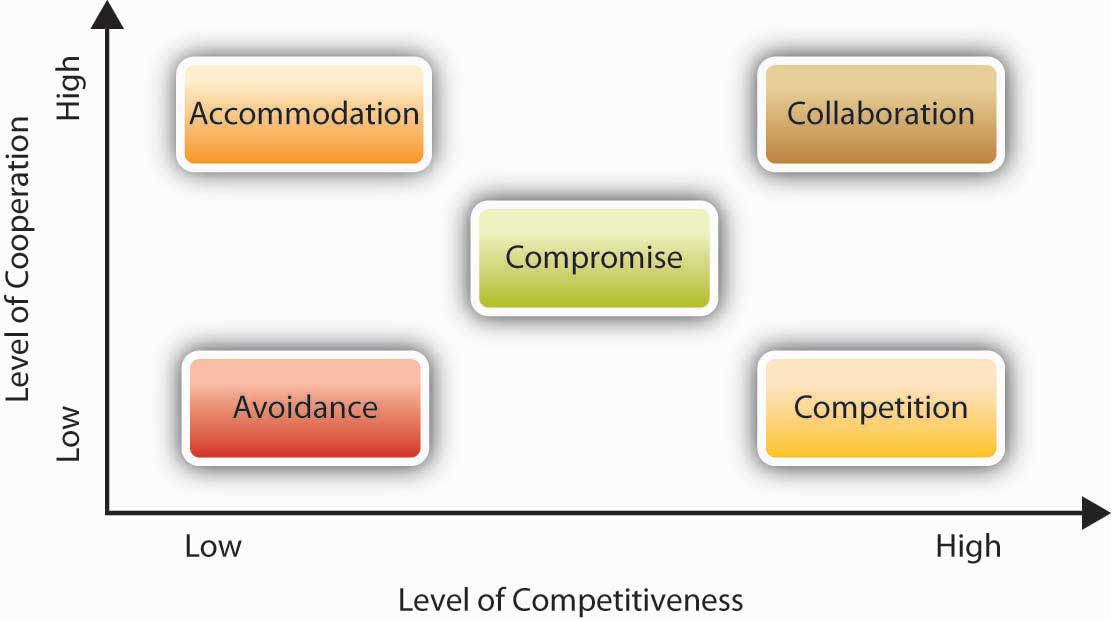
Review conflict handling styles in Conflict Management and page 9 of Negotiation: Theory and Practice.
1c. Define the distinction between managing conflict and resolving conflict
- Define and describe some ways to overcome the following causes of workplace conflict: organizational structure, limited resources, task interdependence, incompatible goals, personality differences, and communication problems.
- When should a manager manage a conflict rather than resolve it?
- When should a manager resolve a conflict rather than manage it?
Many people use the terms conflict management and conflict resolution interchangeably. However, you may waste time, money, and opportunity if you choose to resolve an unsolvable problem or if you continue to manage a problem you could easily solve.
Conflict management refers to containing conflict rather than removing it. Conflict resolution occurs when you take steps to improve or remove a conflict situation, and all parties are satisfied or agree to strive for a win-win solution. Resolving these conflicts may require third-party intervention, such as diplomacy for straightforward negotiations, mediation, and arbitration.
For example, when resolving a business conflict, managers try to determine their company's best outcome. Is your relationship with an employee who produced shoddy work more important than retaining a client who is dissatisfied with the employee's poor performance? One manager may manage the conflict by looking for ways to improve the employee's performance and finding another way to placate their client. Conversely, another manager may prioritize retaining a valuable client and resolving the conflict by replacing the employee.
Review different conflict types in Analyzing a Dispute, Understanding Conflict, and Causes and Outcomes of Conflict.
1d. Identify various objectives of and obstacles to successful negotiation
- Define and describe the five phases of negotiation.
- Explain strategies for determining your best alternative to a negotiated agreement (BATNA), seller's reservation, buyer's reservation, bargaining range, and the zone of possible agreement (ZOPA).
- Define concession.
- Define the distributive, integrative, and mixed-motive negotiation strategies.
- Identify some obstacles to a successful negotiation, such as overconfidence bias, hindsight bias, anchoring, framing bias, escalation of commitment.
- Describe some strategies for avoiding these obstacles.
- Define how negotiators may use a third party during an alternative dispute resolution (ADR).
- When should managers use mediation or arbitration to help resolve a dispute?
The five traditional negotiation phases include investigation, determining your best alternative to a negotiated agreement (BATNA), presentation, bargaining, and closure. Thorough preparation is key to any successful negotiation and will help you avoid choosing an inferior or suboptimal alternative. During the bargaining phase of your negotiation, you may decide to concede certain concessions to obtain a more desired goal.
People enter into negotiations to add benefit, claim something they value, or create an acceptable solution to a problem. Unfortunately, people frequently fail to express their underlying concerns, issues, or goals when they state their position and supporting arguments. This failure to clearly identify and communicate goals and objectives creates many obstacles to achieving a successful outcome. Businesses may need to employ a third party when the original participants cannot arrive at an agreeable solution.
Review the five phases of negotiation, mediation, and arbitration in Negotiations. Review BATNA and ZOPA in Negotiation: Theory and Practice. Review obstacles to negotiation in Faulty Decision-Making.
1e. Explain how we can optimize our decision making
- Define groupthink and explain how it can contribute to suboptimal decision making.
- Define and explain the difference between consensus and majority rule.
- Explain why many people say that two heads are always better than one when making decisions.
- Define functional and dysfunctional conflict and explain how functional conflict benefits group decision making.
- Define and explain the difference between conflict management and conflict resolution.
- Define and provide an example of bullying in the workplace.
- Explain why managers should use conflict management or conflict resolution to address bullying.
- How should managers resolve interpersonal conflict?
Decision-making and problem-solving tools and models are available to help businesses solve problems systematically and rationally. While this course does not focus on decision-making tools in detail, we usually benefit from having a diversity of opinions and various ideas to choose from when deciding our best alternative or course of action. We negotiate from a position of strength when we can see all of our available options (including those of the other party) and understand where the other person is coming from, so we can make a decision that benefits everyone involved.
We are frequently asked to make a decision, as a member of an informal group, business team, volunteer committee, or board of directors.
Group Decision-Making describes five types of group decisions:
- Members identify alternatives but do not decide on a course of action (the authors call this a "plop");
- Members delegate their decision-making to an expert;
- Members reach a middle ground or take an average of all the opinions;
- Members accept the decision of the majority or two-thirds of voting members;
- Members reach a consensus in which everyone agrees with the decision.
Decision-Making in Groups describes eight negative characteristics of groupthink that can prevent groups from choosing the best alternative:
- Illusion of invulnerability;
- Collective rationalizations;
- An unquestioned belief in the group's inherent morality;
- Stereotyped views of outgroups;
- Direct pressure;
- Self-censorship;
- Illusions of unanimity;
- The emergence of self-appointed mind-guards.
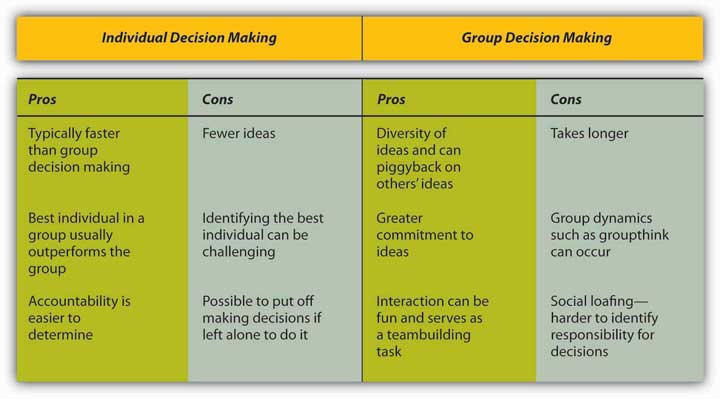
Review some pros and cons of individual versus group decision making in this figure.
Advantages and Disadvantages of Different Levels of Decision Making
Functional conflict can be a positive force for change in the workplace by fostering new, innovative, and more efficient ways to accomplish tasks or goals. However, promoting functional conflict in the workplace is not easy. It requires a delicate balance of encouraging people to challenge one another about their ideas, choices, and preferences without negativity. Unfortunately, misunderstandings and personal clashes can also create dysfunctional conflict and a caustic work environment.
Review Conflict Is Normal and page 444–447 of Workplace Violence and Bullying.
Unit 1 Vocabulary
This vocabulary list includes some terms that may help you answer some of the review items above and some terms you should be familiar with to successfully complete the final exam for this course.
- Accommodative style
- Alternative dispute resolution
- Anchoring bias
- Arbitration
- Avoiding style
- Bargaining Tactics
- Better alternative to a negotiated agreement (BATNA)
- Bullying
- Buyer's reservation point
- Collaborative negotiation style
- Communication problems
- Competitive negotiation style
- Competition
- Compromise
- Conflict
- Conflict accommodation
- Conflict avoidance
- Conflict management
- Conflict of process
- Conflict of misperceived differences
- Conflict of substance
- Conflict of value
- Conflict resolution
- Consensus
- Distributive negotiation strategy
- Dysfunctional conflict
- Escalation of commitment
- Framing bias
- Functional conflict
- Groupthink
- Hindsight bias
- Incompatible goals
- Integrative negotiation strategy
- Intergroup conflict
- Interpersonal conflict
- Intrapersonal conflict
- Interests
- Limited resources
- Majority rule
- Manage
- Mediation
- Mixed motive negotiation strategy
- Organizational structure
- Overconfidence bias
- Personality differences
- Power
- Relationship conflict
- Relationship management
- Resolve
- Rights
- Seller's reservation point
- Task interdependence
- Zone of possible agreement (ZOPA)
Unit 2: Negotiation Strategies and Biases
2a. Explain the distinction between positional bargaining and interest-based bargaining
- Define positional bargaining and interest-based bargaining.
- Explain the distinction between positions and interests in negotiation.
Positional bargaining focuses on what the negotiators want. In this type of negotiation, parties hold onto a fixed idea or position and are not concerned with underlying interests. The parties focus on the outcome – divide a fixed pie to claim value – and discussions frequently become adversarial.
Interest-based bargaining focuses on why the needs, concerns, and desires of the negotiators are important. Since the parties are concerned about underlying issues, they look for ways to collaborate and expand the pie to create value. Negotiators focus on achieving mutually-agreeable terms and preserving their personal or business relationships. We also call interest-based bargaining: problem-solving, integrative negotiation, win-win.
For example, is it more important for a manufacturer to simply state his terms of a transaction to a valued but reluctant supplier (position) and possibly lose future transactions, or would it be better to attempt to find creative ways to satisfy the needs of both parties (interests) to preserve a good working relationship?
To review, see Negotiations and Introduction to Augmenting the Bargaining Zone.
2b. Identify the framework of five negotiation strategies and their strengths and weaknesses in resolving conflict
- What is an example of a competitive negotiation strategy?
- What is an example of a cooperative negotiation strategy?
As we explored in Unit 1, when comparing the strengths and weaknesses of different negotiation approaches, we should examine the importance of the relationship and outcome to the parties. For example, business owners often need to decide whether it is better to lose the trust of an important customer (relationship) to obtain a short-term gain (outcome).
Review this figure to consider the business owner's best strategy.
Conflict-Handling Styles
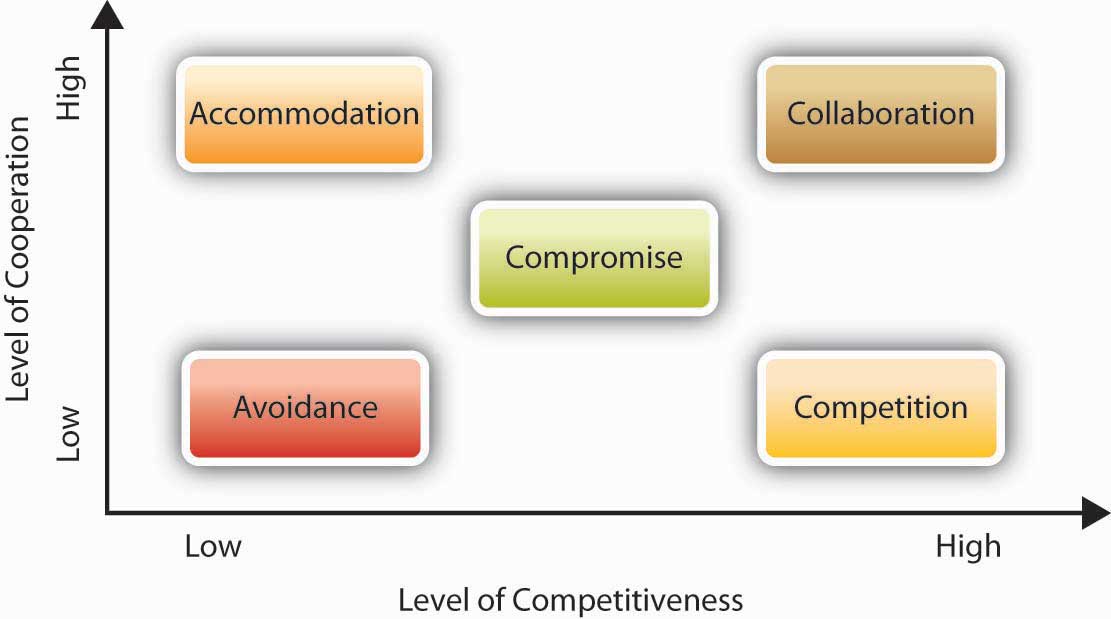
To review, see Conflict-Handling Styles.
2c. Identify types of biases that influence our emotions and attitudes and affect our decision-making
- Define and explain how the four main cognitive biases – confirmation bias, anchoring bias, halo effect, and overconfidence bias – influence our decision making.
- How would knowledge of the endowment effect help a real estate broker negotiate a selling price for a house?
Because decision making is a cognitive activity, various beliefs and preconceptions influence our objectivity. We may derive inferior or suboptimal conclusions based on distorted ideas, misjudgments, and past experiences that do not apply to the current situation, rather than rational thinking. Four common cognitive biases include confirmation bias, anchoring bias, halo effect, and overconfidence bias.
For example, homeowners tend to overvalue the houses they plan to sell because they are emotionally attached to their property. A real estate broker can present objective market data to convince the seller their price is unrealistically high. Potential buyers do not have the same unique appreciation for the house. The endowment effect may prevent buyers and sellers from negotiating a mutually-agreeable price.
To review, see Cognitive Biases as a Barrier to Decision Making. Review gender differences in this type of decision-making bias in Gender Differences in the Endowment Effect: Women Pay Less, but Won't Accept Less.
2d. Explain the importance of controlling our emotions to succeed in negotiating
- Explain how emotions can help or hinder successful negotiations.
- What are some advantages of critical thinking?
Recognizing Stereotypes and Bias discusses why critical thinking is important to reach informed and objective conclusions. The author reminds us that emotions can help or hinder our ability to think critically: "emotions that allow you to deny reality generally produce undesirable results; emotions that encourage you to explore alternatives based on principles of fairness and justice can produce very desirable results".
The author explains that "previous situations, personal histories, general assumptions about an issue – may need to be examined themselves" to avoid making incorrect decisions.
Unit 2 Vocabulary
This vocabulary list includes some terms that may help you answer some of the review items above and some terms you should be familiar with to be successful in completing the final exam for this course.
- Anchoring bias
- Cognitive bias
- Emotional bias
- Halo effect
- Interest-based bargaining
- Motivational bias
- Negotiation phases
- Overconfidence bias
- Positional bargaining
- Social perception biases
- Stakeholders
- Stereotype
- The endowment effect
Unit 3: Processes and Phases of Negotiation
3a. Identify and explain the principles, strategies, and tactics of effective negotiation and professional relationship management
- Define and describe the difference between a strategy and a tactic.
- Name some key negotiation tactics parties use to support distributive, integrative, and mixed-motive negotiation strategies.
A negotiation strategy refers to the overall plan you decide to use and follow to achieve your goals. In Unit 1 we learned that when selecting a negotiation strategy that involves collaboration, an approach employing competition, accommodation, avoidance, or compromise strategies can be more or less effective.
Tactics are the tools of strategy. For example, tactics describe the techniques or methods you decide to use to build a stronger relationship with the other party to ensure an outcome that more effectively supports your strategic goals. For example, negotiation tactics may include pretending to walk away from a negotiation, bluffing, or responding to a proposal with silence.
Some tactics, such as sharing information, are more effective when your goal is to achieve a mutually-desirable outcome – to create joint value. On the other hand, each party may employ competitive tactics in a distributive or mixed-motive negotiation, to emphasize the need to obtain a satisfactory outcome – to claim value. Remember that tactics can be ethical and unethical. If the parties aim to build honesty and trust, employing deceptive tactics, such as withholding relevant information, will negatively-impact future relationships.
To review, see Conflict Management.
3b. Identify and assess the variables in negotiations
- Define the variable factors in a distributive negotiation: asking price, target price, reservation point, walk-away point, and alternative solution.
- How do these factors affect the zone of possible agreement (ZOPA)?
- Define and explain some typical subjects for concession in bargaining.
In a distributive (win-lose) negotiation, one party gets what they want most, but the other party may be forced to relinquish something they value. Examples of variable factors in negotiation include asking price, target price, reservation points, walk-away points, and alternative solutions.
During a negotiation, the items negotiators consider subject to trade-off or concession may have a positive or negative impact on the variables above. Typical concessions include money, time, resources, responsibilities, and autonomy.
Review how these variables affect the ZOPA in Distributive Bargaining. Review a brief example of a distributive approach in Negotiations. Review the negotiation process, prenegotiation, and making concessions in Collaborate to Negotiate.
3c. Develop reliable planning techniques
- Define and list four activities negotiators should accomplish during the prenegotiation stage of negotiation.
- What questions should negotiators ask during the investigation phase of negotiation?
We often find ourselves in situations where we are asked to provide information or give responses we are not prepared to give. We frequently need time to review our options before we can make an informed decision about our best alternative. Prior planning and preparation will help you achieve a satisfactory agreement that is in your best interest.
For example, you should determine your best alternative to a negotiated agreement (BATNA) before you enter a negotiation so you are prepared to negotiate. Arrive at the bargaining table with a clear definition of your goals and be able to name the concessions you would be willing to make or trade. Once you have identified and evaluated your best alternatives, you can measure any proposals you are asked to accept against your optimal standard or best case scenario.
Review prenegotiation in Collaborate to Negotiate and the investigation stage in Negotiations.
3d. Explain the difference between distributive and integrative negotiation
- For a distributive negotiation, explain why a competitive or collaborative strategy is more appropriate.
- For an integrative negotiation, explain why a competitive or collaborative strategy is more appropriate.
During a distributive negotiation, your objective is to obtain the best terms from your negotiation, regardless of whether you and the seller become friends. You probably do not want to make any concessions because you are not interested in forming a relationship. For example, you are not planning to make any future purchases from the seller.
Consider the variables we use when considering buying a car. Let's assume price is a major factor in your decision-making. What is the highest price you are willing to pay? What would you like to pay? What additional factors, such as low mileage, an extended warranty, or additional features, might convince you to pay a higher price? You have researched the alternative models available. Consider the seller. What is the published selling price? What price does the seller want, and what is the lowest price they will accept? At what point will you or the seller walk away from the negotiation?
In our car buying example, the outcome is important to each party. The buyer wants to pay the least amount, and the seller wants to receive the highest amount of money. Neither party is planning to negotiate a future transaction – building or preserving a relationship is not important. The seller may not get their target price and the buyer may need to pay more than planned. The seller may have other buyers lined up and the buyer may have better alternatives. Each can walk away from the transaction if they cannot agree.
Now let's consider an employee who is asking their employer for a raise. If the employee likes their job, they may work with their employer to find other ways to pay for a salary increase or accept other types of compensation acceptable to both parties in lieu of a raise, such as more vacation, a parking space, or other benefits. Unlike the car purchase, the employee and employer want to achieve a mutually-agreed-upon salary outcome and preserve their relationship.
This situation calls for a collaborative or problem-solving approach. Both parties want to achieve a satisfactory outcome for themselves and each other. Another term for this approach is integrative negotiation.
To review, see Negotiations and Distributive Bargaining.
3e. Describe the concepts of Game Theory
- Define a zero-sum game.
- Explain how a negotiator's expectations may affect their attitude toward negotiating in a zero-sum game situation, and whether they adopt a competitive or collaborative negotiation strategy.
- Explain how the Prisoner's Dilemma illustrates game theory.
Wikipedia describes game theory as "the study of mathematical models of conflict and cooperation between intelligent rational decision-makers". A zero-sum game takes place in a competitive negotiation where the goals of the parties are interconnected: when one person achieves their goal the second person does not. One person's success negatively impacts the other. For example, in this distributive situation, both parties compete for a limited or fixed resource, such as a "fixed pie", which may have six slices. When one party takes one slice, the second party only gets five, rather than the whole pie. When one party wins, the second one loses.
According to the Prisoner's Dilemma, two prisoners would be better off if they cooperated with each other and remained silent when being interrogated. However, each side has an incentive to defect and maximize their own gains by accusing their partner of committing the crime. This may reduce their own jail time if their partner remains silent, but they are not sure the other will cooperate. If they both accuse the other, they will both go to jail. In the end, both sides suffer because they fail to work together and tried to maximize their own gain.
To review, see Hobby Lobby and the Zero-Sum Game and The Prisoner's Dilemma.
3f. List the phases of negotiation and their relevance to an effective negotiating outcome
- Why is it important to gather information before beginning a negotiation?
- What should you do if the other party rejects your best offer?
As we reviewed in Unit 1, thorough preparation is key to any successful negotiation because it will help you avoid choosing an inferior or suboptimal alternative. The five traditional phases of negotiation include investigation, determine your best alternative to a negotiated agreement (BATNA), presentation, bargaining, and closure.
During the first phase of negotiation (investigation phase), each party should determine what they want to achieve from the negotiation (their goals), and what they are willing to concede or not concede during the bargaining phase to reach an agreement. When you are armed with this knowledge, you can make informed choices during the negotiation. A negotiator ignores this information-gathering phase at their peril.
During the fifth and final phase of negotiation (closure), you may gain some valuable insight if the other party rejects your best and final offer. Ask them what it would take to reach an agreement if you were to negotiate further. Your willingness to learn from your opponent may prompt them to re-open the door to negotiations you may have assumed were closed.
Review the importance of the five phases of negotiation in Negotiations.
Unit 3 Vocabulary
This vocabulary list includes some terms that may help you answer some of the review items above and some terms you should be familiar with to be successful in completing the final exam for this course.
- Alternative solution
- Asking price
- Collaborative negotiation strategy
- Competitive negotiation strategy
- Concessions
- Distributive negotiation
- Game theory
- Integrative negotiation
- Investigation stage
- Outcome
- Prenegotiation stage
- Problem-solving approach
- Prisoner's dilemma
- Relationship
- Reservation point
- Strategy
- Tactic
- Target price
- Third-party negotiations
- Variables
- Walk-away point
- Zero-sum game
Unit 4: Managing Different Types of Business Negotiations
4a. Identify and describe negotiation theories, concepts, and tactics to manage negotiations as well as professional relationships
- Describe the importance of Warden's four areas of negotiation: goals, strategy, issues, and planning.
- Define and explain how negotiators use behavioral, rational, and structural power tactics in their negotiations.
- Define the six sources of power: legitimate, referent, expert, reward, coercive, and informational.
- Describe how people respond to those who use these three power tactics.
What is Negotiation? describes four parts to a negotiation: goals, strategy, issues, and planning. Each area can help ensure optimal outcomes. Strategy Planning explains that planning your negotiation strategy involves considering the outcomes you wish to achieve and knowing whether you want to maintain a long-term relationship with the other party. This determination will help you decide whether you should take the other party's needs into account as you calculate whether certain proposals are in your own best interest.
Negotiators often use power tactics to "push or prompt others into action". For example, they can use three categories of power tactics (behavioral, rational, and structural) in different ways to achieve their goals.
Review these power tactics and sources of power in Sources of Power.
4b. Describe and assess the importance of various factors that impact negotiations, including specific issues in question, different stakeholder positions, interests, relationships, and group dynamics
- Define stakeholder.
- Why is trust such an important basis for sustainable profitability?
- Define agent and principal.
- Describe the two categories of duties an agent owes their principal: fiduciary duty and a set of general duties imposed by agency law.
- Define collective bargaining.
- What legislation defines and regulates collective bargaining in the United States.
- Define mediation and arbitration.
The Essence of Negotiation explains that "the best business runs on sustainable arrangements". To create sustainable business benefits, business relationships need to change. Stakeholders should promote a win-win strategy during negotiations to instill trust among the negotiating parties. The article lists ten steps for successful business negotiation.
An agent is someone who has the authority to act on behalf of another (the principal). The agent has a fiduciary responsibility to act in the best interest of the principal. Their professional duty also includes avoiding self-dealing, preserving confidential information, using skill and care, demonstrating good conduct, keeping and rendering accounts, not attempting the impossible or impracticable, obeying the principal, and giving information to the principal.
In the United States, the National Labor Relations Act of 1953 covers most collective bargaining agreements in the private sector. The resolution of collective bargaining disputes often involves arbitration.
To review, see Collective Bargaining. Review agents and their responsibilities in Duties between Agent and Principal.
4c. Develop and execute effective negotiation strategies and tactics for different scenarios
- Describe how you might negotiate a salary increase from your employer in terms of the five steps of negotiation.
- Describe some items that may be open to negotiation when you receive a job offer that includes cash and non-cash components.
Research and communication are critical to conducting a successful negotiation, including salary negotiation.
For example, for Phase 1 (investigation), you should define your best alternative to a negotiated agreement (BATNA) by researching what other companies pay people to perform similar job functions in your area so that you can demand a comparable and reasonable salary. Determine your acceptable salary range: this is your bargaining range, which will serve as a guide for your zone of possible agreement (ZOPA) with your employer. Decide whether you will accept any concessions or other benefits your employer may offer instead of a salary increase (see below). You might compile a list of reservations you (as the seller) have so you can ask your employer to rectify any concerns you have with some acceptable solutions.
Phase 2 refers to your presentation. You should be able to clearly communicate your past successes with the appropriate evidence that explains why you are a valuable employee and deserve a raise. Describe the future contributions you will provide the company if given the opportunity. During Phase 1, you should have prepared to respond to any reservations your potential employer (the buyer) may have, so you can explain why any of these areas of concern are not really problematic. Phase 3 involves bargaining where you may have to agree to certain concessions, and Phase 4 describes the final stage where you and your employer close the deal.
Employers typically offer financial rewards and other types of compensation during salary negotiations. For example, cash components may include your base salary, periodic bonuses, and sales commissions. Typical non-cash components include paid holidays and vacation, sick leave, health and dental insurance, stock options, retirement account contributions, tuition reimbursement, and parking or mass transport subsidies. Employers can offer potential employees these additional incentives during the bargaining phase of salary negotiations. During collective bargaining, union representatives may argue that employers should provide these benefits to their employees when negotiating on behalf of their union members.
To review, see Negotiation and Closing the Offer and Items Open to Negotiation: Cash and Noncash Components.
Unit 4 Vocabulary
This vocabulary list includes some terms that may help you answer some of the review items above and some terms you should be familiar with to be successful in completing the final exam for this course.
- Acquisitions
- Agent
- Arbitration
- Coalitions
- Collective bargaining
- Collaborative negotiation strategy
- Competitive negotiation strategy
- Fiduciary duty or responsibility
- Interest-based bargaining
- Mergers
- Moves and turns
- Multi-party business negotiations
- Positional bargaining
- Principal
- Stakeholder
Unit 5: Conflict Resolution
5a. Identify and employ effective communication, problem-solving, and influence techniques appropriate to a given situation
- Define and explain the difference between substantive and affective conflicts.
- When contrasting mediation to arbitration, which strategy is appropriate only for parties willing to participate in the process?
Review Unit 1, where we examined different conflict management methods and conflict resolution (see learning outcome 1c). We examined ways to open communication channels to negotiate and work collaboratively with others. This process includes taking steps to reserve judgment and eliminate negative biases (see Unit 2), recognize cultural differences (see Unit 6), and consider a variety of viewpoints when making decisions and solving problems (see Unit 1). In this way, we can promote functional conflict to solve problems, promote innovation, and create mechanisms to avoid dysfunctional conflict.
Substantive conflict in the workplace refers to conflict that occurs when employees disagree about team strategies, policies, or work procedures. Managers should take steps to embrace this type of functional conflict to channel ideas to make quality improvements and incorporate productive and innovative change.
Affective conflict refers to disagreement that occurs due to interpersonal relationships among team members. These types of conflicts can quickly become dysfunctional and damage employees' ability to work together as a team in pursuit of a common goal.
Both types of conflict can occur within an organization (intra-organizational) or among two or more organizations (inter-organizational).
Alternative dispute resolution (ADR) refers to the use of a third-party to resolve disputes. Businesses usually try to resolve these disputes through negotiation and mediation, rather than arbitration, because court cases can be extremely time-consuming and expensive.
In mediation, the authority remains with the parties themselves. Arbitration creates a legally-binding contract: parties may have agreed to submit to arbitration or have been required to do so by state or federal law.
A Continuum of Different ADR Methods
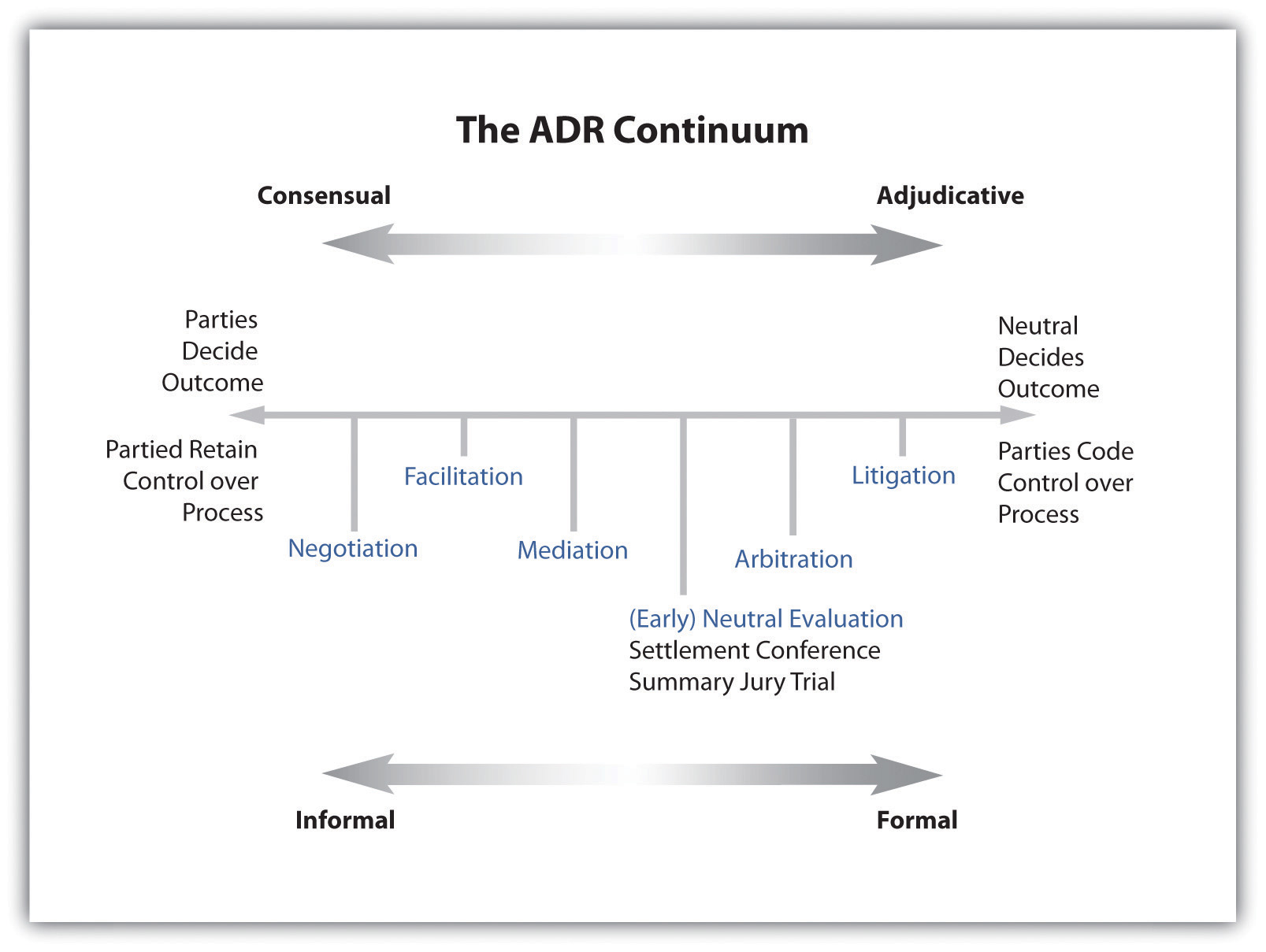
To review, see Managing Conflict. Review Alternative Dispute Resolution and the benefits and drawbacks of mediation and arbitration in Alternative Dispute Resolution, Mediation, and Arbitration.
5b. Diagnose negotiating problems
- Define and list three types of conflicts in the workplace: intrapersonal, interpersonal, and intergroup.
As we explored in Unit 1, workplace conflict can range from minor disagreements to bullying or workplace violence. Conflict can occur within an individual, between people, or among different groups. While dysfunctional conflict is clearly unproductive and destructive, a moderate amount of conflict can be a "healthy and necessary part of organizational life" when disagreement among employees is channeled respectfully and used to garner new ideas and further the ends of the organization.
To review, see Understanding Conflict.
5c. Describe new negotiation ideas and practices
- Describe the difference between traditional and transformative mediation.
- Describe a major challenge to resolving conflict in a technology-driven organization.
From a transformative perspective, conflict is primarily about human interaction rather than a violation of rights or conflicts of interest. This type of conflict intervention does not seek an immediate resolution to a problem but emphasizes recognition, emotions, and empowerment.
In this article, two conference presenters discuss the need to address conflict resolution and human interaction in technology. The lack of face-to-face communication is a significant problem in online interaction, where external entities, such as human resource departments, the law, or government, are typically unavailable to resolve disputes. The presenters describe the challenge of working with technicians who can be reticent to talk about feelings and emotions.
The presenters aim to engage engineers in presentations that tout the potential of conflict and "to explore ways to acknowledge its presence in our communities in a more healthy way".
To review, see Transformative Mediation and Teaching Open Source Communities about Conflict Resolution.
Unit 5 Vocabulary
This vocabulary list includes some terms that may help you answer some of the review items above and some terms you should be familiar with to be successful in completing the final exam for this course.
- Affective conflict
- Alternative dispute resolution (ADR)
- Arbitration
- Federal Arbitration Act (FAA)
- Interpersonal conflict
- Intrapersonal conflict
- Inter-organizational
- Intra-organizational
- Mediation
- Substantive conflict
- Transformative mediation
Unit 6: International and Cross Cultural Negotiation
6a. Explain how culture affects negotiations
- Explain how understanding cultural norms affect negotiations.
- Name some challenges to intercultural negotiation and describe some ways to overcome them.
- Define cultural intelligence (CQ).
Culture refers to the beliefs, values, mindset, and practices of a group of people. Due to these cultural norms, people who come from different cultures often behave in ways that are unfamiliar to us, unacceptable according to our cultural values, or they may interpret the facts and purposes of negotiation in different ways.
Finding a Common Language in Intercultural Negotiation states that language and recognizing different cultural norms are challenges inherent in negotiating across cultures. It offers advice on overcoming language barriers, recommends you read a guidebook to learn about the geography, history, and general practices in the other country, and recommends learning what the other country hopes to gain from the negotiation to create a winning solution for both sides.
Review how people from various cultures respond to issues such as conflict, trust, use of information, and proposals offered during the negotiation process in Ethical and Cross-Cultural Negotiations, Culture and Business, What Is Culture, Anyhow?, and Chinese Nonverbal Communication.
You will want to explore cultural traditions in different countries and how businesses use their understanding of different cultural norms during intercultural negotiations. Even if you do not believe or agree with some of these stereotypes, it is helpful to know the person you are negotiating with may hold them. To review, see Cultural Awareness Should Come from Both Sides, Arab Women as Business Leaders will Always be the Exception, The United States and the Arab World, Business in Mexico, Latino vs. Hispanic: Constructing a New America, and How to do Business in China.
6b. Identify characteristics of culture or national identity that negotiators should become familiar with before engaging in cross-cultural or international negotiations
Review the characteristics of culture or national identity negotiators should become familiar with before engaging in cross-cultural or international negotiations in learning outcome 6a above.
6c. Explain how Trompenaars' and Hofstede's theories of cultural dimensions can be applied to cross-cultural and international negotiations
- Define and explain how the seven dimensions of Trompenaars' Model of National Culture differences apply to cross-cultural and international negotiations.
- Define and explain how the six cultural dimensions in Geert Hofstede's Dimension of Culture Theory apply to cross-cultural and international negotiations.
Fons Trompenaars (1953–), a Dutch management consultant, created a model to compare national cultural differences that addresses the seven dimensions. Five of these dimensions address differences in the way people relate to each other. During global negotiations, these descriptions can help participants anticipate, recognize, and respond to various cultural values, beliefs, practices, and mindsets. Again, even if you do not believe or agree with some of these stereotypes, it is helpful to know the person you are negotiating with may hold them.
- Universalism vs. particularism;
- Individualism vs. communitarianism;
- Neutral vs. emotional;
- Specific vs. diffuse;
- Achievement vs. ascription;
- Sequential vs. synchronic;
- Internal vs. external control.
Geert Hofstede (1928–), a Dutch social psychologist, created a cultural dimensions framework that examines cross-cultural communication to compare national cultures across six dimensions. Hofstede describes how culture affects individual values and how these values can affect human behavior.
- Power distance;
- Uncertainty avoidance;
- Individualism vs. collectivism;
- Masculinity vs. femininity;
- Long-term orientation;
- Indulgence vs. restraint.
To review, see Trompenaars' Model of National Culture Differences and the Interview with Fons Trompenaars. Review Geert Hofstede's Dimensions of Culture Theory in Types of Organizational Culture and Intercultural Communication.
6d. Describe the types of political and legal issues that might arise during the course of international negotiations
- What is the main purpose of the General Agreement on Tariffs and Trade (GATT) and the World Trade Organization (WTO)?
- Why should business leaders try to understand the economic, political, and social culture of a country or region in which they wish to do business?
The General Agreement on Tariffs and Trade (GATT) was a legal agreement created in 1948 to promote international trade by reducing and eliminating trade barriers, such as tariffs or quotas. During their Uruguay Round negotiations, which spanned from 1986 to 1993, its member countries replaced GATT with the World Trade Organization (WTO), which first met on Jan. 1, 1995. The WTO's main purpose is to serve as a forum for member countries to negotiate and adjudicate trade agreements and participate in dispute resolution for trade in goods, services, and intellectual property.
Review international trade laws and institutions in Introductory Trade Issues. Review the WTO's role in international negotiations and how the WTO has adapted to the rise of emerging market economies in The World Trade Organization (WTO) and The WTO and the Future of International Organizations. Also, review Political Impact on Global Negotiations and China's Response to TTIP Negotiations.
Unit 6 Vocabulary
This vocabulary list includes some terms that may help you answer some of the review items above and some terms you should be familiar with to be successful in completing the final exam for this course.
- Achievement vs. ascription dimension
- Cultural intelligence (CQ)
- Fons Trompenaars' Theory of Cultural Dimensions
- Free trade
- Geert Hofstede's Dimensions of Culture Theory
- The General Agreement on Tariffs and Trade (GATT)
- Individualism vs. communitarianism dimension
- Individualism vs. collectivism dimension
- Internal control vs. external control dimension
- Long-term orientation and restraint dimension
- Masculinity vs. femininity dimension;
- Neutral vs. emotional dimension
- Power distance dimension
- Sequential vs. synchronic dimension
- Specific vs. diffuse dimension
- Tariff
- The Trans-Pacific Partnership (TPP)
- The Transatlantic Trade and Investment Partnership (TTIP)
- Uncertainty avoidance dimension
- Universalism vs. Particularism dimension
- The World Trade Organization (WTO)