 Print book
 Print this chapter
Monetary Policy and the Fed
Read this chapter to understand in more detail the monetary policy tools, process, and impacts on the U.S. economy. Review specific monetary policies and their effects from our recent history.
Problems and Controversies of Monetary Policy
Case in Point: The Fed and the ECB: A Tale of Divergent Monetary Policies
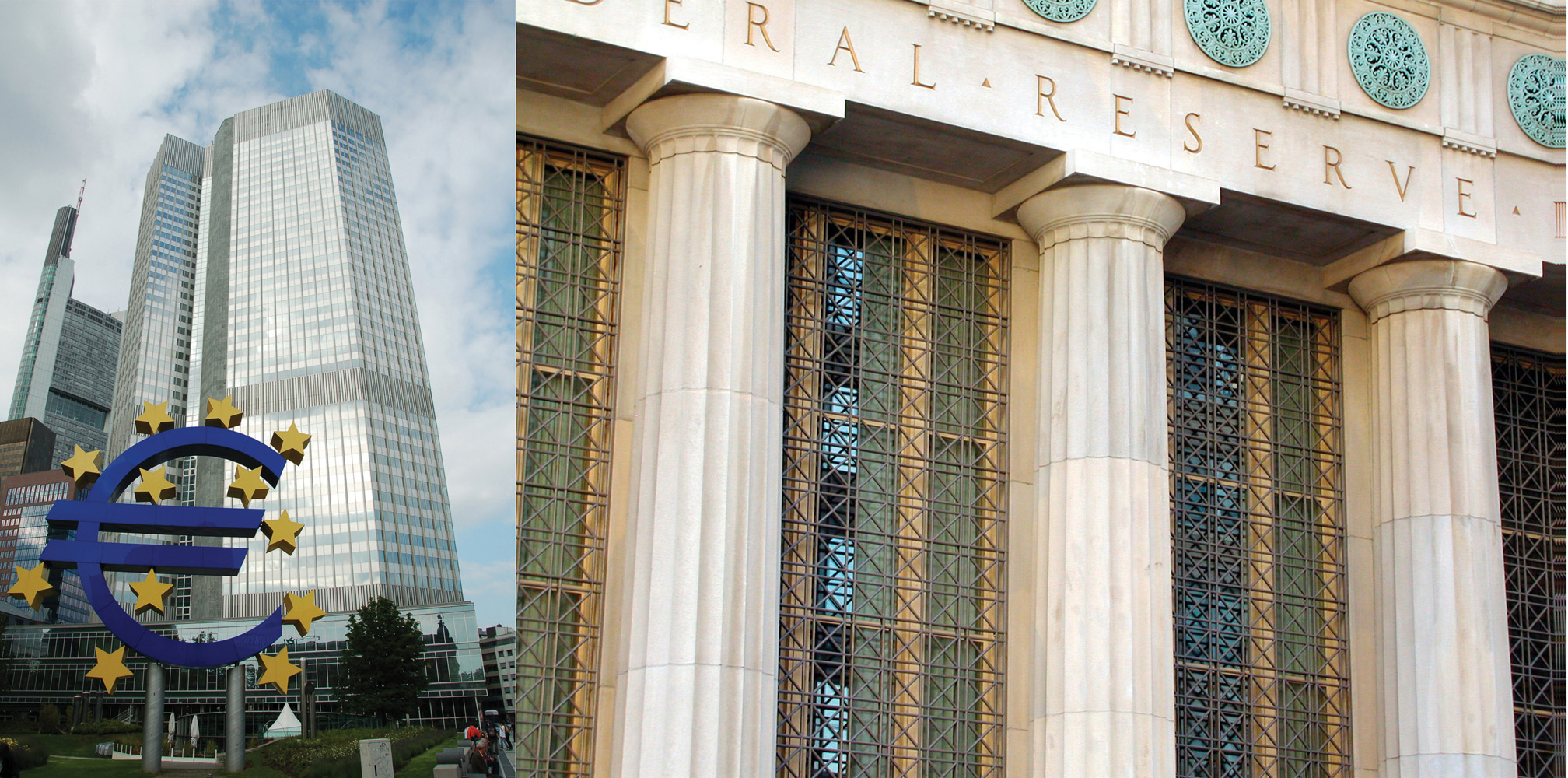
In
the spring of 2011, the European Central Bank (ECB) began to raise
interest rates, while the Federal Reserve Bank held fast to its low rate
policy. With the economies of both Europe and the United States weak,
why the split in direction?
For one thing, at the time, the U.S.
economy looked weaker than did Europe's economy as a whole. Moreover,
the recession in the United States had been deeper. For example, the
unemployment rate in the United States more than doubled during the
Great Recession and its aftermath, while in the eurozone, it had risen
only 40%.
But the divergence also reflected the different legal
environments in which the two central banks operate. The ECB has a clear
mandate to fight inflation, while the Fed has more leeway in pursuing
both price stability and full employment. The ECB has a specific
inflation target, and the inflation measure it uses covers all prices.
The Fed, with its more flexible inflation target, has tended to focus on
"core" inflation, which excludes gasoline and food prices, both of
which are apt to be volatile. Using each central bank's preferred
inflation measure, European inflation was, at the time of the ECB rate
hike, running at 2.6%, while in the United States, it was at 1.6%.
Europe
also differs from the United States in its degree of unionization.
Because of Europe's higher level of unionization and collective
bargaining, there is a sense that any price increases in Europe will
translate into sustained inflation more rapidly there than they will in
the United States.
Recall, however, that the eurozone is made up
of 17 diverse countries. As made evident by the headline news from most
of 2011 and into 2012, a number of countries in the eurozone were
experiencing sovereign debt crises (meaning that there was fear that
their governments could not meet their debt obligations) as well as more
severe economic conditions. Higher interest rates make their
circumstances that much more difficult. While it is true that various
states in the United States can experience very different economic
circumstances when the Fed sets what is essentially a "national"
monetary policy, having a single monetary policy for different countries
presents additional problems. One reason for this this difference is
that labor mobility is higher in the United States than it is across the
countries of Europe. Also, the United States can use its "national"
fiscal policy to help weaker states.
In the fall of 2011, the ECB
reversed course. At its first meeting under its new president, Mario
Draghi, in November 2011, it lowered rates, citing slower growth and
growing concerns about the sovereign debt crisis. A further rate cut
followed in December. Interestingly, the inflation rate at the time of
the cuts was running at about 3%, which was above the ECB's stated goal
of 2%. The ECB argued that it was forecasting lower inflation for the
future. So even the ECB has some flexibility and room for discretion.